Physiology · Urinary system
Renal water regulation: permeability, gradient and reabsorption
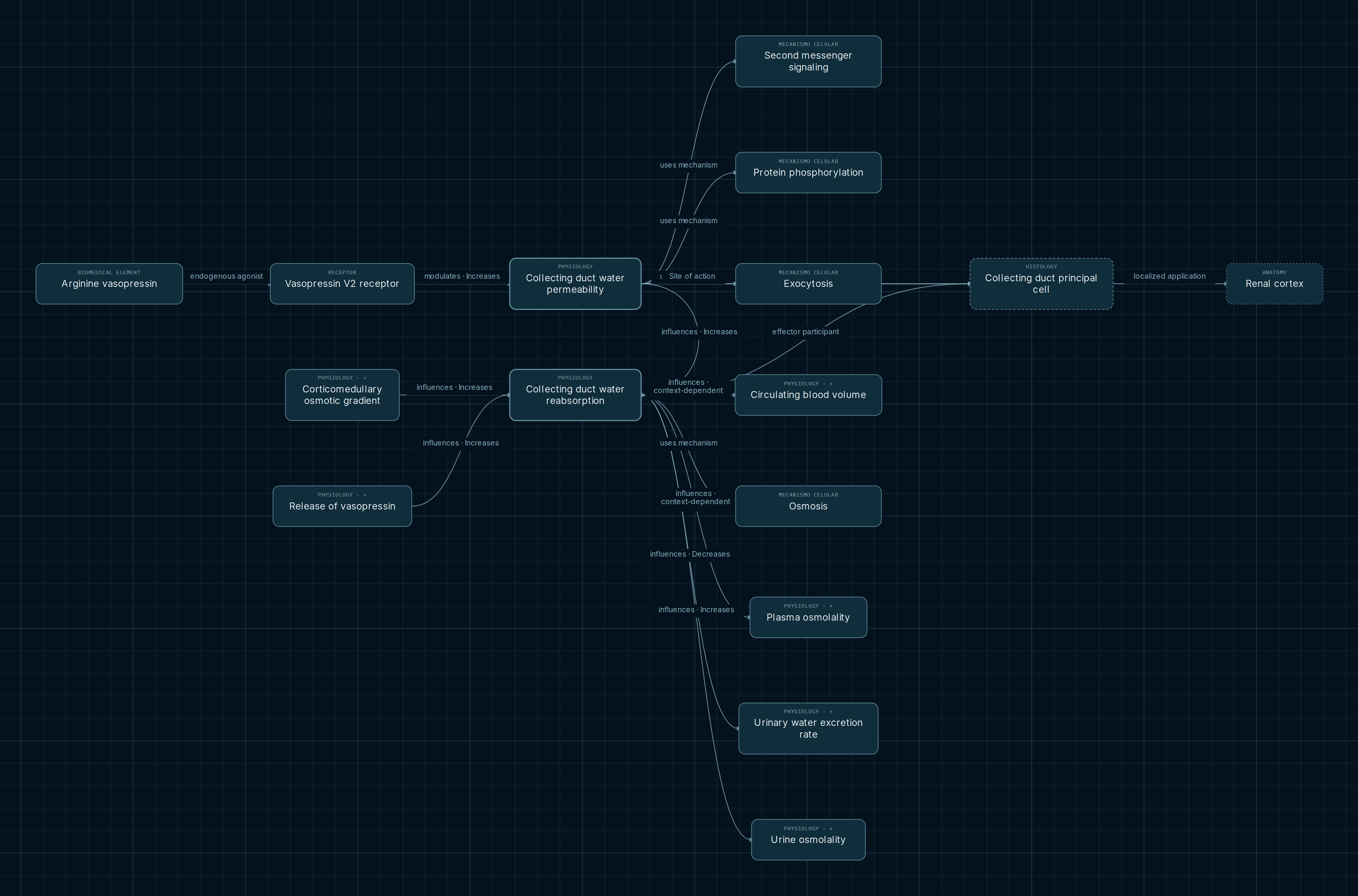
Conserving water requires a hormonal signal, a permeable membrane and an osmotic driving force to work together. This view brings collecting duct permeability and water reabsorption into one map, separating what vasopressin changes, what the gradient enables and how the outcome relates to urine and the circulation.
Explore this map in the AtlasOpens both functions with receptors, mechanisms and histological context expanded.
The map
What each connection means
Start with the two selected nodes. Permeability describes the capacity for passage; reabsorption describes flow toward the interstitium. Physiological arrows carry effects and conditions. Links to mechanisms or cells describe participation without turning all the elements into a single chronological sequence.
- Increases or decreases
- The sign describes a relationship under stated conditions. Greater permeability favors reabsorption when a favorable gradient and luminal water remain available.
- Uses a mechanism
- Exocytosis, second messenger signaling and phosphorylation are branches associated with permeability regulation. Osmosis describes water movement.
- Participant and site of action
- The principal cell connects function and receptor to a tissue context. Its cortical application does not represent every cell throughout the collecting system.
Two connected functions
Hormonal signal and receptor
Vasopressin release is an endocrine process; arginine vasopressin identifies the ligand. Its connection to V2 relates that signal to permeability. Connecting these explanatory levels does not mean that release, local concentration and receptor activation are interchangeable measurements.
Capacity and osmotic driving force
Permeability and the corticomedullary gradient converge on reabsorption. A more permeable membrane does not independently produce net osmotic flow. The gradient cannot ensure that flow when the barrier remains poorly permeable. The notes preserve these conditions beside each effect.
Conditional consequences
Reabsorption reduces water excretion at unchanged distal delivery. It raises urine osmolality when the excreted osmole load remains constant. Links to circulating blood volume and plasma osmolality are context dependent and are recorded as editorial proposals.
From receptor to membrane: mechanism and experimental scope
The notes associate V2 with cAMP signaling, PKA/AQP2-related phosphorylation and apical insertion by exocytosis. The map stores associations between permeability and these mechanism classes; it does not store an exclusive sequence of steps between them. AQP2 appears in the explanation without becoming an additional molecular node in this view.
Yip studied isolated, perfused rat inner medullary collecting duct segments. The study measured intracellular calcium, apical exocytosis and permeability, examining responses to AVP and experimental interventions. It supports the mechanism within that preparation; it does not directly demonstrate it in human cortical collecting ducts. The histological application in this view explicitly retains that extrapolation.
Urine concentration and whole-body balance
More concentrated urine does not demonstrate greater solute excretion: it may reflect less water accompanying a similar solute load. Water excretion rate is also distinct from voiding frequency and glomerular filtration rate. These remain different variables even when they change together in an actual physiological setting.
Water conservation can help sustain circulating volume, but distribution between body compartments, intake and other losses modify the outcome. For the same reason, the plasma osmolality link does not predict a numerical value. This reading separates a renal influence from a complete solution of whole-body water balance.
Vasopressin regulates permeability; water moves by osmosis
Hormonal regulation changes one condition for transport. It does not pump water or replace the gradient. Follow the receptor–permeability branch and the osmotic input separately before interpreting the resulting reabsorption.
Explore for yourself
- Follow the permeability and gradient inputs to reabsorption. Open their notes and compare the conditions required for each effect.
- Inspect the V2, mechanism and principal cell branches. Identify which links describe regulation and which mechanism describes water movement.
- Compare urinary outputs with blood volume and plasma osmolality. Check evidence labels and conditions before inferring a whole-body change. Some notes remain in their original Spanish.
Opens both functions with receptors, mechanisms and histological context expanded.
Scope and sources
This view integrates selected relationships rather than a quantitative model or the complete control of vasopressin. The cortical application is representative and does not impose a uniform cell identity on terminal papillary epithelium. Partial support and editorial proposals remain explicit in the notes.
References recorded in Atlas notes and checked for this guide. Distinguish the primary experiment from teaching texts, pharmacological nomenclature and histological context:
- Yip KP. J Physiol. 2002;538:891–899. DOI: 10.1113/jphysiol.2001.012606. Abstract/results: calcium, exocytosis and permeability in rat; introduction: V2/cAMP/AQP2 context.
- OpenStax/Rice. Anatomy and Physiology 2e, 25.6. Loop of Henle and collecting ducts: gradient, permeability and reabsorption.
- OpenStax/Rice. Anatomy and Physiology 2e, 17.3. Posterior pituitary and antidiuretic hormone.
- Bichet et al. IUPHAR/BPS, Vasopressin and oxytocin receptors, v2025.3. Abstract and V2 receptor link.
- MedlinePlus/NLM. Osmolality Tests. Solute concentration and water balance.
- Duke University. Urinary System. Cortical context and segment distinctions; teaching specimens have identified species.