Executive summary
Over the centuries, medicine has accumulated an extraordinarily extensive body of scientific knowledge. However, much of that knowledge continues to be expressed through texts, documents, classifications and information systems that do not always allow direct computational relationships to be established between their components.
At the same time, clinical practice generates enormous amounts of information about patients, diseases, treatments and outcomes. This information is often distributed across narrative records, laboratory results, images, forms and heterogeneous institutional systems.
Recent advances in artificial intelligence have considerably expanded the ability to interpret and process unstructured medical information. However, probabilistic language interpretation and the persistent, verifiable and reusable representation of knowledge are different technological problems.
KatavMD originated from the proposal to integrate both capabilities: structured biomedical knowledge and interpretation assisted by artificial intelligence.
Developed by Neora Systems, KatavMD is a technological infrastructure intended to represent medical knowledge through a computable biomedical graph, connect that knowledge with individual clinical observations and progressively facilitate the analysis of cases, cohorts and health information.
Its architecture encompasses three fundamental components:
- Biomedical Knowledge Graph (KG): a structured representation of general biomedical knowledge.
- Patient Graph (PG): a model for organizing individual clinical observations, events and states.
- Case Builder: a system for interpreting and structuring clinical information through hybrid processing.
Specialized interfaces and engines for biomedical exploration, clinical analysis and research are being developed on this infrastructure.
The first planned public application is KatavMD Atlas, a visual tool for exploring medical concepts and their relationships through diagrams generated from structured knowledge.
Capabilities for individual analysis, longitudinal follow-up, cohort research and institutional interoperability are part of the platform's planned evolution and are at different stages of development.
KatavMD does not aim to substitute for medical judgment or replace existing electronic health record systems. Its purpose is to develop a complementary layer of computable knowledge that facilitates the interpretation, organization and exploration of biomedical information.
Component status as of October 2026
| Component | Status |
|---|---|
| Biomedical Knowledge Graph | Implemented in PostgreSQL and queryable through internal tools. Its coverage and review continue to expand. |
| KatavMD Atlas | Navigable local prototype; the first public beta is in preparation, with selected initial coverage. |
| Patient Graph and Case Builder | Design and experimental implementations under development; not available as a public clinical service. |
| Research Engine and institutional integrations | Planned capabilities subject to development, pilots and validation. |
1. The challenge: fragmented medical knowledge and clinical information
1.1. The evolution of medical knowledge
From its earliest systematic formulations to contemporary medicine, medical knowledge has evolved through clinical observation, experimental research, technological development and scientific review.
This process has produced multiple disciplines, terminologies, classification systems and documentation methods.
Although international standardization efforts exist, biomedical information continues to exhibit terminological, structural and contextual differences across specialties, institutions and countries.
The same clinical phenomenon may be described using different expressions, while related concepts may be spread across separate documents and categories.
These differences hinder the automatic integration of information and the systematic comparison of records from different sources.
1.2. The problem of clinical records
Information produced during medical care often combines structured and unstructured elements.
These include clinical narratives, diagnoses, physical examination findings, laboratory measurements, imaging reports and longitudinal records.
Electronic health systems have significantly improved the availability and organization of these data. However, digitizing a document does not necessarily mean converting all its content into semantically structured and comparable information.
A clinical description may contain relevant information that remains within a text field and is not directly accessible for statistical analysis without further processing.
This problem becomes particularly important when studying information accumulated over time or drawn from multiple patients and institutions.
1.3. Artificial intelligence and knowledge persistence
Language models have demonstrated significant capabilities for interpreting narratives, extracting information and facilitating access to medical knowledge.
However, their responses can vary depending on the context, the wording of the query and the characteristics of the model used.
For this reason, KatavMD distinguishes between two functions:
Interpreting information through artificial intelligence and representing knowledge through persistent, explicit structures.
AI models can assist in interpreting and transforming information, while the Knowledge Graph provides a canonical framework of concepts and relationships to which integrity, traceability and consistency controls can be applied.
This separation is one of the fundamental principles of the architecture.
2. The KatavMD proposal
KatavMD proposes a computable biomedical knowledge infrastructure that connects three dimensions:
- General medical knowledge.
- Individual clinical observations.
- The analysis of clinical and population information.
The proposal is not limited to storing medical concepts or generating answers through artificial intelligence.
It involves establishing a system in which biomedical concepts have canonical identities and can be related through explicit connections, allowing clinical observations to be linked to that knowledge.
This aims to facilitate the reuse of structured information, the exploration of mechanisms and the development of research tools.
2.1. Architectural principles
Persistence: structured knowledge is preserved independently of AI interpretation sessions.
Canonical identity: concepts are organized through identifiers that allow them to be referenced consistently.
Semantic relationships: connections represent specific types of biomedical relationships rather than only generic associations.
Compositionality: knowledge components can be reused in different clinical representations.
Separation of knowledge and observation: general medical statements are distinguished from documented facts about individual patients.
Extensibility: the architecture is designed to incorporate new entities, relationships and knowledge domains.
Traceability: the aim is to preserve the provenance and context needed to review and interpret information.
These principles guide the design of KatavMD, although their implementation and validation continue to evolve.
3. Biomedical Knowledge Graph
3.1. Computable representation of knowledge
The Biomedical Knowledge Graph is the conceptual core of KatavMD.
It is a mechanism-oriented biomedical representation, built using canonical entities and semantically typed relationships, with persistence implemented on relational database infrastructure.
The KG integrates different levels of medical organization, including:
- Anatomy.
- Histology and cell biology.
- Physiology.
- Pathophysiology.
- Receptors and biomolecular mechanisms.
- Pharmacology.
- Clinical semiology.
- Clinical entities and relationships between diseases.
The purpose is to represent connections between these domains through a structure that can be queried and processed computationally.
3.2. Anatomical example
An anatomical structure can be represented as an entity with its own identity and explicit relationships to other structures.
For example, the arterial tree can be organized through connections between vascular segments, branches and anatomical regions.
Similarly, musculoskeletal structures can be related through attachments, joints and other anatomical connections.
The value of this representation lies not only in listing structures, but also in preserving the relationships that make their organization understandable.
3.3. Physiological and pharmacological example
A biomolecular receptor can be connected to endogenous ligands, pharmacological agents and related physiological processes.
In this way, the same concept can participate in multiple pathways without duplicating its canonical definition.
The representation allows connections between physiological processes and pharmacological intervention mechanisms to be explored, within the coverage and conditions recorded in the KG.
3.4. From physiology to clinical entities
One of KatavMD's objectives is to connect general biomedical mechanisms with clinical entities.
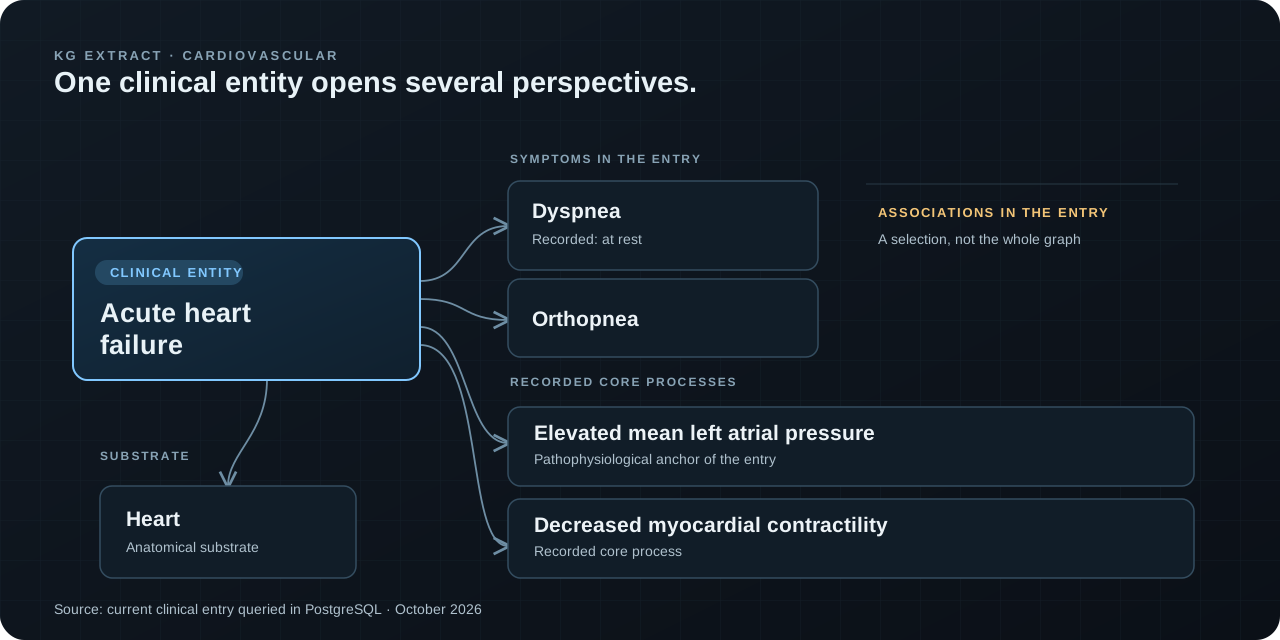
A disease can be linked to pathophysiological changes, anatomical structures, clinical manifestations and other related diseases.
This allows clinical projections to be built from previously represented components.
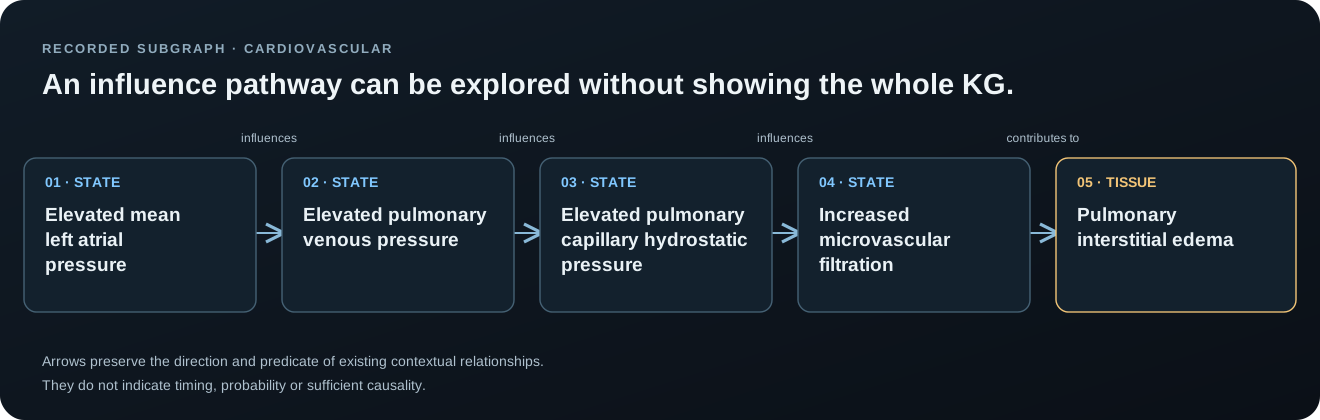
However, a stored relationship does not automatically imply causality, frequency, temporal sequence or universal applicability.
Connections must be interpreted according to their predicates, conditions and context.
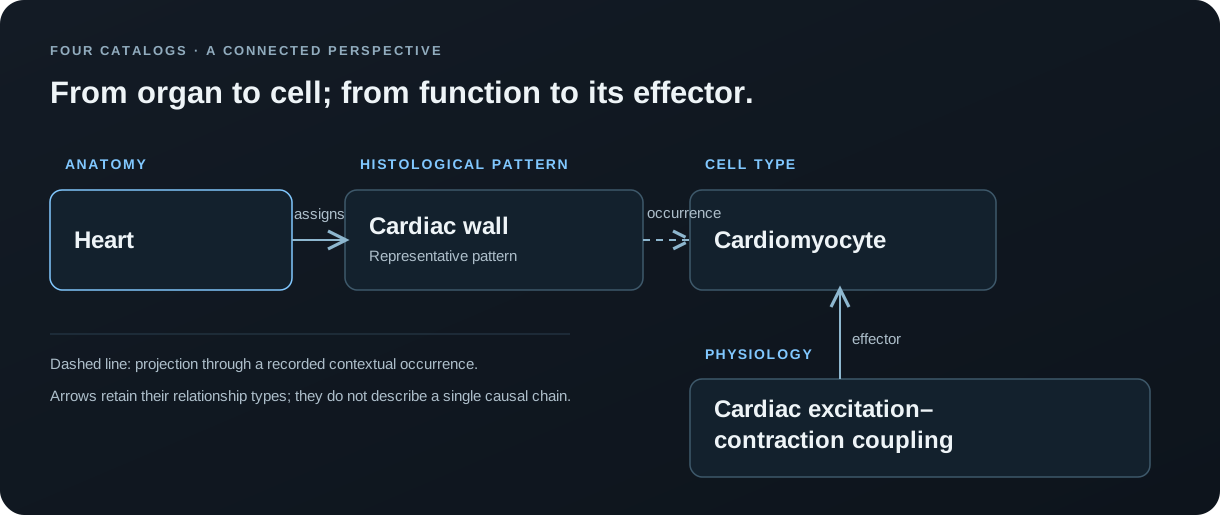
A specific subset of the KG shows the heart linked to a cardiac wall histological pattern and a cardiomyocyte occurrence; through another relationship, the cardiomyocyte participates as an effector in excitation–contraction coupling. The combined view helps explore different levels of organization, but does not turn those connections into a universal causal chain. The figures in this document simplify labels for public reading and preserve that distinction in their captions.
4. Patient Graph: from general knowledge to the individual
Medical knowledge describes general phenomena, while clinical practice records observations about specific people.
These dimensions require different representations.
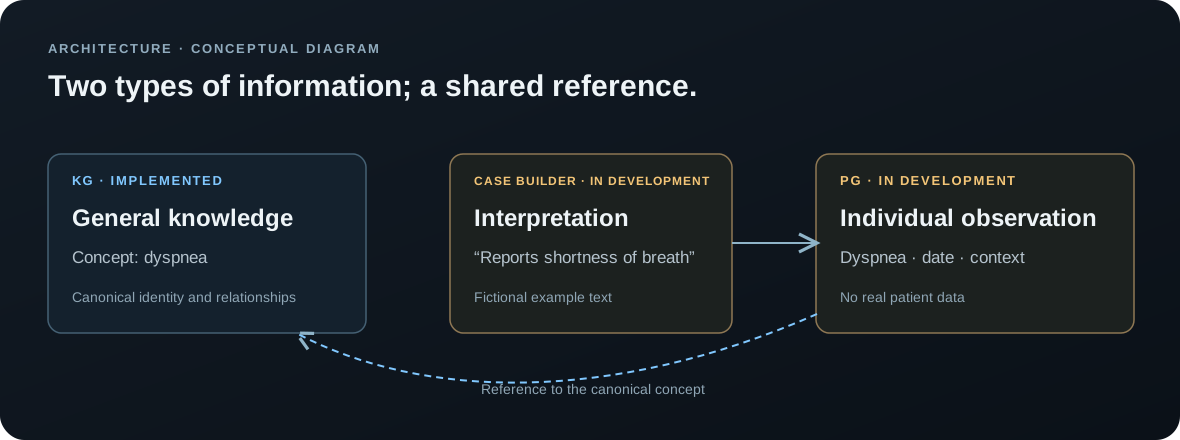
The Patient Graph (PG) is the component designed to organize individual clinical observations, events, measurements and states, using references to the canonical concepts of the Knowledge Graph.
4.1. General knowledge and individual observation
The KG can represent a disease that affects an anatomical structure.
The PG should allow the way that disease manifests in a specific individual to be recorded.
For example, a clinical entity may be related to the kidney as a general anatomical structure, while an individual observation may need to specify laterality, date, severity, provenance and degree of certainty.
The separation between KG and PG preserves these differences without indiscriminately duplicating general biomedical knowledge.
4.2. Longitudinal dimension
The PG architecture provides for the representation of multiple observations and events over time.
Once the corresponding functions have been implemented and validated, this would allow the evolution of clinical variables to be studied, episodes to be compared and longitudinal patterns to be examined.
4.3. Privacy by design
KatavMD is intended to use clinical information while minimizing the need for personal identifiers.
Its model provides for the possibility of representing cases through pseudonymous identifiers and appropriately de-identified clinical data.
The absence of names or other direct identifiers does not by itself guarantee complete anonymization.
Therefore, functions that process real clinical information will require privacy controls, authorizations and security mechanisms appropriate to the type of data and its purpose.
The Patient Graph is not initially intended as a replacement for institutional electronic health records.
5. Case Builder: clinical interpretation and structuring
The Case Builder is the component designed to transform clinical information expressed in natural language into structured representations compatible with the Patient Graph.
Its architecture combines deterministic processing, controlled vocabulary and artificial intelligence techniques.
The objective is to facilitate the identification of documented medical concepts and their correspondence with canonical entities.
5.1. The problem of clinical narratives
A clinical record may describe the same phenomenon through multiple expressions, abbreviations or narrative structures.
It may also include negations, uncertainty, medical history, current observations and references to different points in time.
Converting that narrative into structured information requires distinguishing these elements and preserving their clinical meaning.
5.2. Hybrid processing
KatavMD explores a methodology in which AI models work with computational rules and contracts to identify and organize clinical information.
The expected result is a structured representation that can be reviewed, corrected and linked to canonical knowledge.
This approach aims to reduce dependence on unconstrained interpretations and support verifiable results.
5.3. Development status
Case Builder is under development and experimental evaluation.
Its ability to interpret different formats, specialties and clinical narratives should not be considered universal or fully validated.
Functions for processing real cases will be subject to appropriate privacy and security controls.
6. Applications of KatavMD
The architecture encompasses five main families of applications.
6.1. KatavMD Atlas: visual exploration of medical knowledge
Status: first public application planned for Beta 1.0.
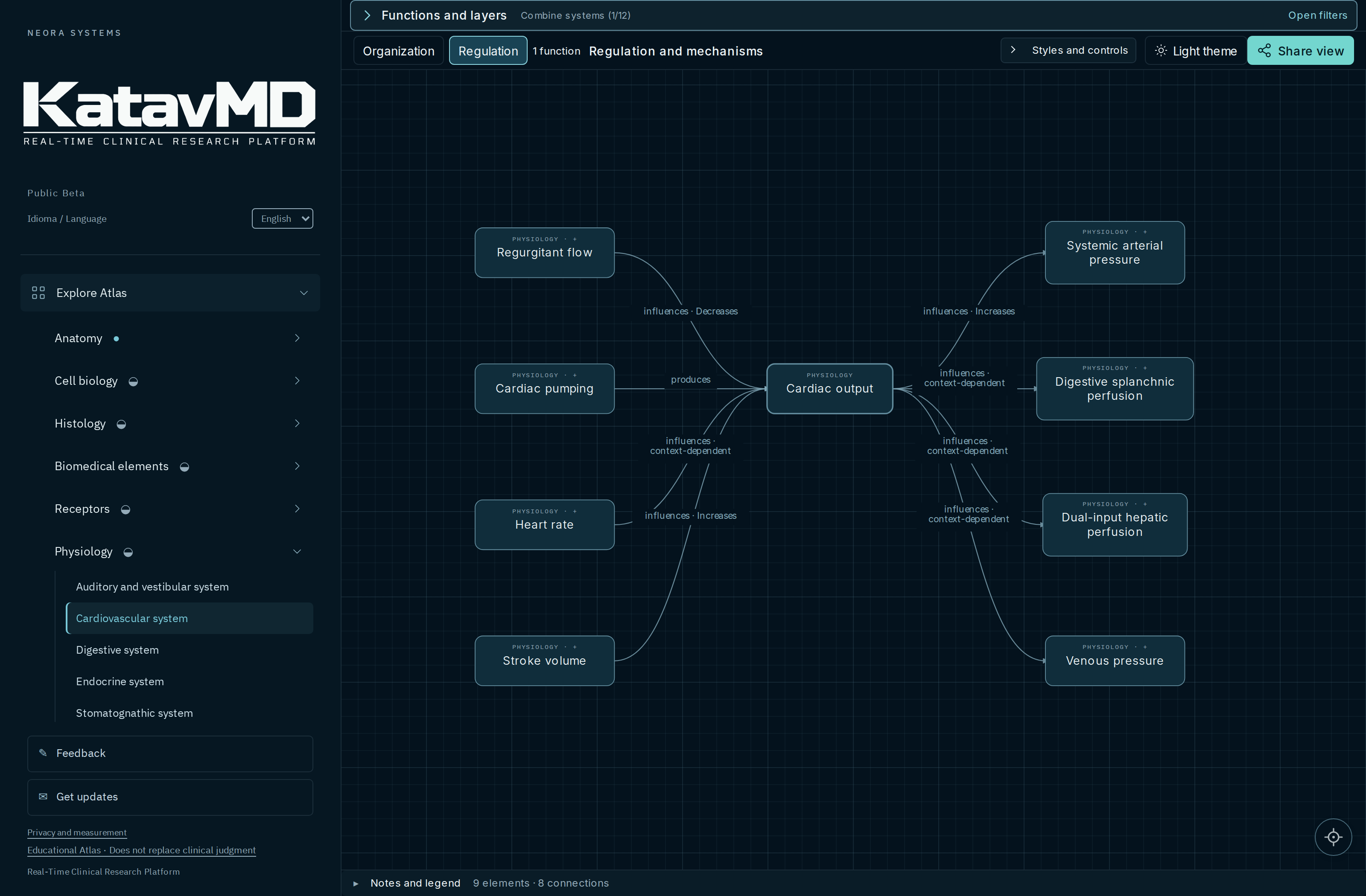
KatavMD Atlas is designed to visually represent biomedical concepts and their relationships through diagrams generated from the KG. A navigable local prototype exists; the public beta version is in preparation.
Its objective is to facilitate the exploration of structures, mechanisms and clinical relationships in a navigable format.
Instead of presenting only sequential texts, Atlas aims to offer graphical perspectives on medical concepts and processes.
Views can be organized by topic, body system and clinical entity, according to available coverage.
The first public version will focus on a selected set of reproducible representations, with a progressive expansion of functionality.
Atlas is a tool for reference and exploration of medical knowledge, not an individual diagnostic system.
6.2. Exploration of individual clinical cases
Status: prototype under development.
The combination of Case Builder, Patient Graph and Knowledge Graph is designed to enable the structured representation of individual cases.
The objective is for physicians to be able to examine documented observations and explore their relationships with biomedical concepts.
Future capabilities could include graphical perspectives on relevant findings, mechanisms and clinical relationships.
The exploration of diagnostic hypotheses will require specific validation and should not be interpreted as an autonomous diagnostic capability that is currently available.
6.3. Longitudinal analysis
Status: functionality planned on the PG architecture.
KatavMD provides for the organization of multiple clinical events belonging to the same individual.
This could allow episodes to be compared, changes in clinical variables to be studied and temporal patterns to be represented.
For example, a series of successive consultations could be analyzed to identify recurring manifestations, variations in measurements and the evolution of findings.
The usefulness of these functions will depend on the quality, continuity and coverage of the available records.
6.4. Clinical research and cohort analysis
Status: Research Engine under development.
The canonical representation of clinical variables can facilitate cohort construction and reproducible analyses.
The Research Engine is intended to allow researchers to select clinical variables, define study populations and carry out analytical procedures on authorized information.
One of its aspirations is to expand the set of variables potentially available for research by reusing previously structured knowledge.
This could facilitate exploratory studies and analyses of multiple clinical dimensions.
However, the availability of relationships in the KG does not imply that all variables are observable in a cohort or that they can be validly inferred from the available data.
Statistical interpretation will continue to require methodological controls, assessment of bias and scientific supervision.
6.5. Interoperability and institutional intelligence
Status: potential institutional application.
KatavMD is designed with the intention of facilitating the organization of clinical information from heterogeneous sources.
In an institutional context, a structuring and canonicalization layer could complement existing health information systems.
Potential applications include generating clinical indicators, epidemiological analyses and exploring population trends.
Frequent updates of these indicators would depend on integrations, permissions, infrastructure and the quality of available data.
KatavMD has not yet demonstrated universal interoperability or real-time national epidemiological operation.
Institutional integrations will require specific pilots and validation.
7. Knowledge engineering and quality control
Building the Knowledge Graph has required an iterative process of conceptual design, formalization, catalog production and review of biomedical relationships.
Neora Systems has developed a knowledge engineering methodology assisted by artificial intelligence agents, under human direction and supervision.
This methodology combines structural specifications, controlled vocabulary, validations and internal auditing mechanisms.
The objective is to promote consistency across domains and allow new concepts and relationships to be incorporated progressively.
7.1. Internal validations
During development, procedures have been used to detect structural inconsistencies, invalid references and integration problems.
Mechanisms for reviewing biomedical content and consulting references have also been incorporated.
These controls are part of the engineering process, but do not by themselves constitute independent certification of scientific accuracy.
7.2. Limitations of the represented knowledge
Biomedical knowledge contains uncertainty, individual variability, conditional relationships and phenomena that cannot always be reduced to discrete structures.
Consequently, the KG may exhibit:
- Incomplete coverage of certain domains.
- Relationships subject to specific conditions.
- Differences in granularity across medical areas.
- Information that requires contextual interpretation.
- Concepts and relationships pending review or expansion.
KatavMD is conceived as an evolving infrastructure rather than an exhaustive and definitive representation of all of medicine.
8. Scientific and technological validation
KatavMD's scientific usefulness requires assessments that go beyond its technical operation.
The planned dimensions of validation include:
Structural integrity: consistency of entities, identifiers and relationships.
Semantic fidelity: correspondence between the represented relationships and their biomedical meaning.
Extraction accuracy: the ability to correctly identify information documented in clinical narratives.
Context preservation: handling of negations, temporality, uncertainty and provenance.
Reproducibility: the ability to obtain consistent results from the same inputs and conditions.
Clinical and research usefulness: assessment of whether the tools facilitate real exploration, structuring or analysis tasks.
These dimensions constitute evaluation objectives.
No independent validation results are yet presented that would support claims of specific levels of clinical accuracy, sensitivity, specificity or superiority over existing tools.
9. Privacy, security and responsible use
KatavMD is being developed under the principle of personal information minimization.
Public exploration through Atlas does not require entering patient records.
Future tools for individual cases and cohorts will be intended to work with appropriately de-identified or pseudonymized clinical information, depending on the context and applicable controls.
Processing real clinical information will be subject to the corresponding privacy, security, authorization and governance requirements.
9.1. Limitations of anonymization
Removing names, identity documents and other direct identifiers does not necessarily guarantee that a clinical record is anonymous.
Certain combinations of demographic characteristics, clinical events, dates and rare conditions may allow a person to be identified indirectly.
Likewise, the use of alternative identifiers or persistent aliases may constitute pseudonymization when records can potentially be linked to a real identity.
For these reasons, KatavMD conceptually distinguishes between anonymization and pseudonymization, and recognizes the need to assess the risk of re-identification according to the nature of the data and its context of use.
The architectural objective is to minimize the need to process personal identifiers, without assuming that such minimization automatically eliminates all data protection obligations.
9.2. Separation between biomedical knowledge and clinical data
KatavMD's architecture distinguishes between general medical knowledge, represented in the Biomedical Knowledge Graph, and observations about individual patients, organized through the Patient Graph.
This separation allows public biomedical exploration tools to operate without requiring access to clinical records.
It also provides an architectural basis for developing differentiated controls over components that may eventually process individual clinical information.
Access to patient data, its persistence, permissions for use and processing conditions must be established according to the functionality actually implemented and applicable requirements.
9.3. Processing of clinical information
KatavMD provides for mechanisms intended to facilitate the transformation of clinical information into structured representations.
Strategies under consideration include de-identification before remote processing, including methods for local review and transformation of information where technically appropriate.
These capabilities require development, testing and validation before they can be considered reliable data protection mechanisms.
Incorporating automated identifier detection tools does not replace the need for authorizations, security controls or assessment of residual risk.
Experimental functionality should not be interpreted as general authorization to enter identifiable clinical records.
9.4. Information security
KatavMD's architecture provides for the separation of public visualization components from internal knowledge and processing systems.
The security design aims to incorporate access controls, minimization of exposed information, protection of communications, operational traceability and restrictions on data processing.
The implementation and evaluation of these controls correspond to each component and deployment stage.
KatavMD does not claim to currently hold independent information security certifications or universal regulatory authorizations to process identifiable medical data.
Future institutional implementations will be subject to security, privacy and compliance assessments according to their context of use.
9.5. Clinical scope and professional supervision
KatavMD is an infrastructure for exploring, structuring and analyzing biomedical knowledge and information.
Its graphical representations and computational relationships do not in themselves constitute clinical diagnoses, individualized therapeutic recommendations or definitive scientific conclusions.
The existence of a relationship between medical concepts does not necessarily imply causality, frequency, diagnostic relevance or applicability to a specific patient.
Clinical analysis functions are being developed as tools to support professional interpretation and require assessment of their capabilities, errors and limitations.
KatavMD does not replace clinical judgment, care protocols or the responsibilities of healthcare professionals.
10. Current status and roadmap
KatavMD is at a stage of progressive development and validation.
Its initial biomedical knowledge infrastructure has reached a level of development that allows diagrammatic representations of multiple medical domains to be generated.
The project advances through a modular strategy, in which different applications can be incorporated progressively without requiring all biomedical knowledge to be represented from the initial launch.
10.1. KatavMD Atlas Beta
First planned public application.
Atlas is the first accessible manifestation of KatavMD's knowledge infrastructure.
Its initial version focuses on the visual exploration of biomedical concepts through selected views, generated from relationships stored in the Knowledge Graph.
The beta release prioritizes a navigable, understandable and reproducible experience.
Initial coverage will be partial and may expand progressively as structured knowledge, visualization tools and review processes evolve.
10.2. Patient Graph and Case Builder
Components under development and experimental evaluation.
The Patient Graph is designed to represent individual clinical observations through references to canonical knowledge.
Case Builder aims to facilitate the transformation of clinical narratives into structures compatible with this model.
Initial implementations aim to test the feasibility of the representation, data integrity and the usefulness of the results.
The incorporation of new input modalities and the processing of longitudinal records will depend on their development and validation.
10.3. Research Engine
Component under development.
The Research Engine is intended to use structured information from the Patient Graph and relationships from the Knowledge Graph in clinical research procedures.
Its development encompasses mechanisms to select variables, define cohorts and carry out analyses on available and authorized data.
Initial evaluations will seek to establish the technical feasibility, reproducibility and methodological usefulness of these capabilities.
10.4. Institutional integrations
Future application subject to pilots and specific agreements.
KatavMD considers the possibility of integrating as a complementary knowledge and analysis layer on existing health information systems.
Integrations will depend on available formats, access policies, data quality, security requirements and the needs of each institution.
Automatic compatibility with all electronic record systems or immediate availability of real-time population analysis is not assumed.
11. Research and development prospects
KatavMD's architecture is conceived as an evolving infrastructure.
Its future development encompasses both expanding the represented knowledge and creating tools capable of using it to answer biomedical questions.
11.1. Expansion of knowledge
The Biomedical Knowledge Graph can be expanded by incorporating new concepts, relationships and levels of granularity.
Areas of future interest include specialized representations of oncology, neuroscience and other domains that require greater molecular, physiological or pathophysiological detail.
These extensions constitute research and development opportunities, not currently available functionality.
11.2. Clinical research based on canonical variables
One of KatavMD's aspirations is to help variables represented in biomedical knowledge be linked with clinical observations and, when sufficient data exist, used in research analyses.
This approach could expand the possibilities for exploring previously structured clinical information.
However, the existence of a variable within the KG does not guarantee its availability in individual records or its validity for every analysis.
Variable selection must take into account data quality, clinical context, methodological criteria and statistical limitations.
11.3. Population research and indicator updates
In future institutional settings, KatavMD could facilitate the generation of clinical indicators from updated information sources.
The frequency and timeliness of those indicators would depend on integration, processing and validation capabilities, and on data availability.
The long-term objective is to contribute to the development of tools that allow health information to be analyzed with greater flexibility and reproducibility.
These capabilities will require demonstration through specific studies and pilots.
11.4. Knowledge engineering assisted by artificial intelligence
The methodology developed during the construction of KatavMD also constitutes a potential direction for Neora Systems' technological evolution.
The experience gained suggests opportunities to investigate reproducible processes for building, expanding and maintaining specialized knowledge representations.
The applicability of this methodology to other scientific domains must be assessed independently.
12. Conclusion
Contemporary medicine has an extraordinary volume of scientific knowledge and clinical information at its disposal.
However, the ability to transform that knowledge into computable structures, connect it with individual observations and use it systematically for research remains a significant challenge.
KatavMD proposes addressing this problem through an architecture that integrates canonical biomedical knowledge, individual clinical representations and interpretation tools assisted by artificial intelligence.
Its fundamental proposal is to separate knowledge persistence from probabilistic interpretation processes, allowing both components to work together within a structured infrastructure.
The Biomedical Knowledge Graph forms the foundation of this architecture.
The Patient Graph and Case Builder are designed to connect that foundation with clinical observations, while the Research Engine envisages its future application to individual and population studies.
KatavMD Atlas represents the first step toward public exposure of this infrastructure.
Its beta launch aims to allow healthcare professionals to visually explore medical knowledge, learn about the project's initial capabilities and participate in its evaluation and evolution.
KatavMD does not present itself as a definitive representation of medicine or as a universal solution to the challenges of clinical research.
It presents itself as a technological infrastructure under development, intended to explore new ways of organizing, connecting and using biomedical knowledge.
The next stage will be shaped by scientific validation, user experience, collaboration with professionals and institutions, and the evaluation of real applications.
KatavMD's vision is to help medical knowledge become not only accessible for consultation, but also representable, connectable and computationally usable to facilitate biomedical research.
Neora Systems, S.EP
Panama · 2026
KatavMD — Real-Time Clinical Research Platform · Public Beta.
Note on project status: This document describes an evolving technological architecture. Capabilities identified as planned, experimental or under development should not be interpreted as commercially available functionality. Claims about scientific and clinical usefulness are subject to independent evaluation and validation.